
What is ESOP? How do ESOPs work?
- In simple words, we can say it is just beyond the basic pay package for employers' benefits plan worker-ownership interest in the company. One can take an interest in the form of shares.
- In the case of ESOP, the employee owns the share in the company.
- In the UK, some deductions are the salary package for purchasing shares in the company.
- Employers are provided with a shares option plan to get gen in wages or go for share options in the US.
- In Australia, many employers go for shares to be free from tax. This type of plan may be the selective plan or available for all types of employers.
- If it is only selective, employers who have more experience will be able to have a share. Some companies may need a particular educational qualification and knowledge for all-employee plans.
- ESOP is one of the best methods to boost the knees in the job as they also hold the share in the company
- ESOP helps the employees to buy the shares in the company so that the employers will work hard to ease the succession planning
- This employee stock ownership plan(ESOP) helps in many ways for tax reduction to the owners, so the owners use that to make for the employer's benefits.
Quick Contact
Lets Get In Touch Now
This plan is created to ease the succession planning where the company allows the employers the opportunity to buy the shares in the cooperative stocks. In ESOP, anytime it can be funded or we can spend funds for the welfare of the company, set trust funds, and can be funded by any new company that currently holds a share.
ESOP is not only for the big company any company irrespective of its size, a number of large publicly traded corporations Since everybody in the company buys the shares through the ESOP plan, but the company can also enhance participants’ focus on corporate performance and share price appreciation.
By teamwork, employers will be encouraged to participate more if the company stocks increase. As they are themselves, the shareholder’s employers always think about all the new ways to increase company stocks.
Types of Plan Available in Esop
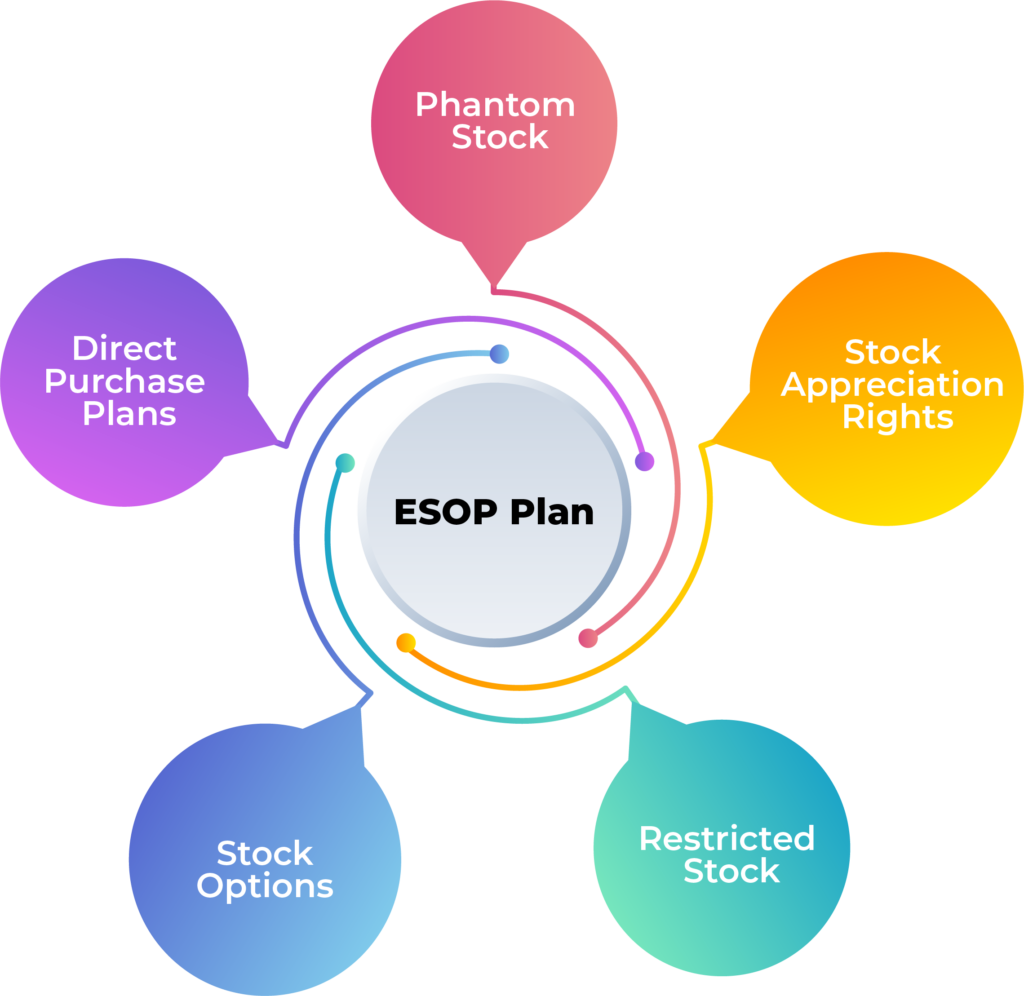
Many plans are available in ESOP; in some plans, employers can buy shares in the company without any initial amount. Sometimes discounts or some stock options may be provided. There may be a holding period before employers take ownership of the particular share. This holding period is called vesting. Based on the employer’s performance and business condition, a vesting period and a stock option will be provided.
In many developing countries, different types of ESOP plans are available, but plans are mainly to recruit and reward senior or key employers
This ESOP plan is widespread in the U.S and U.K. In many countries like Ireland, tax law encourages ESOP.
Various types of employee share ownership plans (ESOP) includes
- direct purchase plans
- stock options
- Restricted stock
- Phantom stock
- Stock appreciation rights
Direct Purchase Plans
In this case, using their money, employers can buy a share. Many qualified plans of tax allow the employers to buy the stocks in the company. For example, ESOP allows an employer to buy the stock by delaying the tax payment for over six to twelve months to buy a 15% share in the company.
They can buy the share at the current price or at the time when they stop paying tax.
In share incentive plans, where the company itself offers their share to the employee for some certain period of 18 months or more
Stock Option
Here the company allows the employers to buy the stocks at the predetermined or prefixed price based on the future. Employers should go with the company whatever the rule it creates
Restricted Stocks
Everyone can’t buy these stocks. It is only for the employers who have to work for many years to receive the right to buy shares, and their experience and educational qualification are up to the level to buy the stocks.
Phantom Stock
The company provides stocks to the senior-most employees without actually providing them it, but they ensure the equity.
Stock Appreciation Rights/ Stock-Settled Sar
Here employers can increase the value of the allotted number of shares. They can increase their share value by paying the cash.
How Does Esops Work?
As everybody knows, ESOP full form is an Employee stock ownership plan where employers can buy the stock in their own company at a discount or low cost. After some period, they can review it by paying again. Even in India, many companies like Flipkart and Myntra started ESOP.
First and foremost, the employer must decide the number of shares, price, and beneficiary employees under ESOP. After that, ESOP grants shares to the employer. Offered ESOP remains as the trust fund is called vesting period for some time intervals.
During this vesting period, the employer can enjoy their ownership in the company as the employer owns stocks.
If the vesting period expires, the employer can buy the share of the company, which will be low compared to the market value. If employers are willing to sell his shares, he can sell to anyone.
If the employers didn’t last for the vesting period, then the company will buy their share. The company will buy the share from the employee within 60 days.
Benefits of Esops for Employees
There are many benefits for the employee through ESOPs. Here are the benefits listed below
- stock ownership
- Dividend income
- Buy shares at a discounted rate
Stock Ownership
The employee can enjoy the ownership of the company with the help of ESOPs. the employee can work hard to increase the capital of the company go that he can also enjoy the benefit
Dividend Income
The company will divide the income if their stocks earn money. Based on the shares, the company will divide the amount. It is like additional income to the employee. An employee can enjoy both company profits and additional earnings by his company shares.
Buy Shares at a Discounted Rate
While buying shares, employees will buy the shares by paying nominal money. It is like the one type of investment in the working company.

Benefits of Esops for Employers
Here are some of the benefits of employers
- Employee Retention
- Better productivity
- A tool for attracting talent
Employee Retention
As there is a vesting period, the employee won’t go to other companies. They remain in the same company to make it easier for the employer.
Better Productivity
ESOP is one of the best methods to boost the knees in the job as they also hold the share in the company. ESOP helps the employees to buy the shares in the company so that the employers will work hard to ease the succession planning
A Tool for Attracting Talent
It is one of the best methods so that employees will remain in the same company until the completion of the vesting period. Employers don’t want to pay high pay packages to the employee. This employee stock ownership plan(ESOP) helps in many ways for tax reduction to the owners, so the owners use that to make for the employer’s benefits.
What Esop Stands For?
As everybody knows, ESOP stands for Employee stock ownership plan where employers can buy the stock in their own company at a discount or low cost. After some period, they can review it by paying again.
This plan is created to ease the succession planning where the company allows the employers the opportunity to buy the shares in the cooperative stocks. In ESOP, anytime it can be funded, or we can spend funds for the company’s welfare, set trust funds, and can be funded by any new company that currently holds a share.
ESOP is not only for the big company any company irrespective of its size, number of large publicly traded corporations
What Is an Example of an Employee Stock Ownership Plan?
Consider an employee who has worked in the company for six years. Under employee stock ownership, if the employee can have the right to receive ten shares after the first year and after five years, he can receive fifty shares. If the worker retires, he can receive the money in the form of cash or check. Many types of ESOP plans are available such as stock option plans, restricted share plans, restricted stock plans, and phantom plans based on one convenience they can choose.
Upfront Cost and Distribution
An employee can buy the shares in the company without any initial cost. First and foremost, the employer must decide the number of shares, price, and beneficiary employees under ESOP. After that, ESOP grants shares to the employer. Offered ESOP remains as the trust fund is called vesting period for some time intervals.
During this vesting period, the employer can enjoy their ownership in the company as the employer owns stocks.
If the vesting period expires, the employer can buy the company’s share, which will be low compared to the market value. If employers are willing to sell his shares, he can sell to anyone.
If the employers didn’t last for the vesting period, they would buy their share. The company will buy the share from the employee within 60 days.
In some companies, if the vested period gets over, the company will purchase the share from the employee so that the employee will get a lump sum based on the plan he has chosen.
Tax Implication of Esops
There are two taxes implemented on the ESOPs plan.
- If the employee buys the shares in the company, tax is implemented
- If the employee sells the shares, tax is implemented
Tax Treatment at Time of Buying the Shares
An employer can buy the shares in the company lower than the market rate(fair market value FMV). One can find more differences between the market value and the exercise value. Based on the income tax slab rate, the tax amount will be determined
Esop Calculation Example
Exercise date | January 1, 2020 |
Fair market value (FMV) | RS – 100/ share |
Exercise price | Rs- 50/share |
Number of shares exercised | 1000 |
The taxable value of perquisite | 100 – 50 = Rs 50/share |
Total taxable perquisite | 1000 * 50 = Rs 50,000 |
Tax payable (assuming a tax slab of 20%) | 20% of 50000 = Rs 10000 |
Suppose your startup company doesn’t worry because the government has relaxed the tax implementation of EOSP, a start-up business. If the start-up has ESOP, they don’t have to pay tax on the prerequisite in the year.
For a startup, TDS will defer to the date given below.
- Five-year completion date from the ESOP grant date
- If the employee sells the ESOP, the date he sells is considered
- If the employee leaves the company, the date he leaves will be considered
Tax Treatment at the Time of Selling the Shares
If the employee decides to sell his shares, the tax would be subjected based on capital gains tax is depends on the selling price of the employee and the Fair market value (FMV) on the date when the share get exercised
If the employee buys a share for 12 months, if he is willing to sell the shares after 12 months means if the gains of the share exceed Rs one lakh, the tax charged will be 10%
If the employee buys a share for 12 months, if he is willing to sell the shares before 12 months means if the gains of the share exceed Rs one lakh, the tax charged will be 15%
In ESOP example 1, you can see the employee purchased the tax on January 1, 2020, and the fair market value as of January 1st, 2020 is Rs 100/share
Exercise date | January 1, 2020 |
Fair market value (FMV) | RS – 100/ share |
CASE 1 – Shares Sold on October 1, 2020
Fair market value on October 1, 2020 | Rs 110/ share |
Difference between the fair market value FMV | 110 – 100 = 10 / share |
Number of shares | 1000 |
The total amount of short-term capital gain | 1000 * 10 = Rs 10,000 |
Short term capital gains tax payable | 15% of 10,000 = Rs 1500 |
CASE 2: Shares Sold on February 2, 2021
Fair market value on October 1, 2020 | Rs 120/ share |
Difference between the exercise fair market value FMV and the sale fair market value (FMV) | 120 – 100 = 20 / share |
Number of shares | 1000 |
The total amount of long-term capital gain | 1000 * 20 = Rs 20,000 |
long term capital gains tax payable | 10% of 20,000 = Rs 2000 nil as the gain is below Rs 1 lakh |
If you buy shares in a foreign company, the same taxation method is also followed in India. Tax will be implemented on perk earnings from the foreign country.
If you use ESOP calculators in India, you can pay the tax on time without any delay rather than allowing yourself to do complex calculations.
What Happens to Esop When the Company Is Listed?
If the unlisted company is willing to sell the share, many company owners won’t show interest in buying them. It is one of the most challenging for the unlisted company to sell shares.
Only a few company owners will show interest in buying them. And the fair market value for the shares sold by the unlisted company.
As per debt funds, the tax will be collected on the profits. For example, if the employees bought the share for 36 months. If the employee thinks of selling the share within 36 months, it is considered as short-term capital gains; the tax implemented on the capital gains will be based on income tax slab rates.
Suppose the employees bought the share for 36 months. If the employee thinks of selling the share after 36 months, it is considered as long-term capital gains; the tax implemented on the capital gains will be 20% with indexation.
If the company is listed, many employees will come forward to buy the share, and the market movement will determine more fair market value.
Problems Related to Esops for the Employers
- Everybody is aware of the benefits of ESOP as it helps the employees to buy the shares in the company so that the employers will work hard to ease the succession planning
- But they are some reason not to go for ESOP as ESOP have complex rules it requires some person to look after into it
- however, many outsource firm is available to look after ESOPs
ESOP meaning is an Employee stock ownership plan that requires proper administration, legal cost, and trust valuation
How can ESOP help a company
ESOP can be a genuine way for a company to enhance its focus on corporate performance. The employees would be motivated to take part in it as the benefits are real.
what are the different plans under ESOP
Direct purchase plan, phantom stock, stock appreciation rights, restricted stock, and stock options are the five different plans that come under ESOP.
Why are restricted stock plans named so
In a restricted stock plan, not everyone is entitled to buy the stock. This restriction gives it the name. Employers who have worked in the company for a pre-determined duration can get the right to buy these stocks. Educational qualifications and experience are taken into account.
Name the benefits of ESOP for employees
Stock ownership, dividend income and the ability to buy shares of the company at discount prices are the benefits of ESOPs.